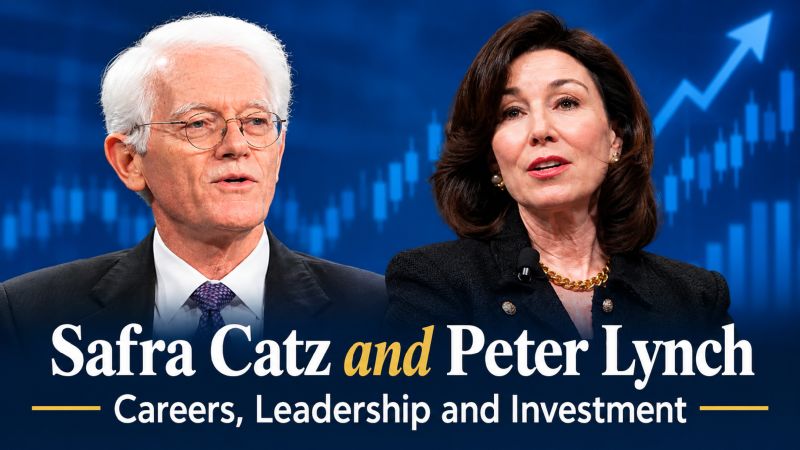
Safra Catz and Peter Lynch are two highly recognized figures whose careers have influenced the worlds of business, technology, finance, and investment. Although they followed very different professional paths, both became known for disciplined decision-making, detailed analysis, and a strong understanding of how organizations and markets work.
Safra Catz built her reputation as a powerful technology executive through her long career at Oracle, where she held senior financial and leadership positions before becoming CEO. Peter Lynch, meanwhile, became one of the best-known investment managers in modern financial history through his management of Fidelity’s Magellan Fund.
Their careers took place in different environments. Catz focused on corporate management, financial strategy, acquisitions, and technology, while Lynch concentrated on researching companies and identifying investment opportunities. Yet their stories share several important themes: preparation, long-term thinking, understanding fundamentals, and making decisions based on evidence rather than emotion.
Who Is Safra Catz?
Safra Catz is an Israeli-American business executive best known for her long association with Oracle. She joined Oracle in 1999 after working in investment banking and eventually became one of the company’s most influential executives.
According to Oracle’s executive biography, Catz previously served as Oracle’s president, chief financial officer, executive vice president, and senior vice president. She has also served on the boards of major organizations outside Oracle.
Catz studied at the University of Pennsylvania, earning a bachelor’s degree and a law degree. Before joining Oracle, she worked at Donaldson, Lufkin & Jenrette, where she became a managing director in investment banking. Her financial background became an important part of her leadership approach at Oracle.
Her career demonstrates how financial expertise can become a powerful foundation for corporate leadership. Rather than focusing only on technology, Catz developed a reputation for understanding the financial and operational side of a large technology company.
Safra Catz and Oracle
Catz joined Oracle during a period when the company was already an important player in enterprise software. Over the following years, she took on increasingly significant responsibilities.
Stanford Graduate School of Business notes that she became a member of Oracle’s board in 2001 and served as CEO beginning in 2014. She previously held positions including president and CFO.
As an executive, Catz became closely associated with Oracle’s acquisition strategy. Acquisitions can be complicated because companies must determine whether another business will provide technological, financial, or strategic value. Catz’s financial background helped make this area an important part of her leadership profile.
Her career also illustrates the importance of understanding more than one side of a business. A technology company needs innovative products, but it also needs careful financial management, efficient operations, and a long-term strategy.
Safra Catz’s Leadership Approach
One of the most notable aspects of Safra Catz’s career is her combination of financial discipline and corporate leadership.
A senior executive must make decisions involving budgets, employees, acquisitions, competition, technology, and future growth. These decisions rarely have simple answers. Catz’s career shows how analytical thinking can help leaders operate in complex environments.
Her background in investment banking also provided experience in evaluating businesses and financial situations. That experience became relevant when she moved into corporate management.
Catz’s professional story can therefore be viewed as an example of how specialized financial knowledge can translate into broader executive leadership.
Who Is Peter Lynch?
Peter Lynch is one of the most famous investment managers associated with Fidelity. He managed Fidelity’s Magellan Fund from 1977 until 1990 and became widely known for his ability to identify companies with significant growth potential.
Lynch’s interest in investing began early. According to a PBS interview, his experience caddying at a country club exposed him to conversations among business executives and helped spark his interest in the stock market.
He later attended Boston College and earned an MBA from the Wharton School of the University of Pennsylvania. After spending time in the Army, he returned to Fidelity and worked as a research analyst.
In 1977, Lynch took over management of the Magellan Fund. PBS records that the fund had approximately $20 million when he took over.
Peter Lynch and the Magellan Fund
Peter Lynch’s time managing Magellan became the defining chapter of his career.
Fidelity’s historical information lists Lynch as the fund’s manager from 1977 through 1990. During those years, the fund grew dramatically and became one of the most famous mutual funds in the United States.
Lynch was known for extensive research. Rather than simply following market headlines, he examined individual companies and attempted to understand how their businesses actually operated.
This approach became one of the reasons his investment philosophy attracted so much attention.
His career also demonstrated that successful investing requires patience. Companies can experience temporary problems, changing economic conditions, and periods when their stock prices do not reflect their long-term potential.
The “Buy What You Know” Idea
One of Peter Lynch’s most famous investment concepts is often summarized as “buy what you know.”
The basic idea is not that investors should purchase every company whose products they use. Instead, Lynch encouraged investors to pay attention to businesses they encounter in everyday life and then conduct proper research.
For example, noticing that a particular retailer is becoming increasingly popular may provide an initial idea. However, that observation alone is not enough to justify an investment. An investor would still need to examine the company’s finances, competition, growth prospects, debt, management, and valuation.
This distinction is important because observation can generate an idea, while research helps determine whether that idea has merit.
Peter Lynch’s Research-Driven Philosophy
Lynch became famous for doing extensive homework before making investment decisions.
Historical accounts describe how he visited companies and paid attention to details beyond financial statements. His research process included examining management and operations and developing an understanding of the businesses he considered for investment.
This approach demonstrates a valuable principle: successful decision-making often depends on asking better questions.
Instead of simply asking whether a stock is rising, an investor can ask:
- What does the company actually do?
- How does it make money?
- Does it have sustainable growth?
- What advantages does it have over competitors?
- Is management effective?
- Does the current valuation make sense?
- What risks could affect the business?
These questions encourage investors to look beyond short-term market movements.
Safra Catz and Peter Lynch: Important Differences
Although both Safra Catz and Peter Lynch worked extensively with financial information, their professional responsibilities were very different.
Catz’s primary focus was corporate leadership. She had to consider the overall performance and strategy of a large technology organization. Her responsibilities involved operations, financial management, acquisitions, and corporate strategy.
Lynch’s responsibility was different. As a fund manager, he researched publicly traded companies and made portfolio decisions on behalf of investors.
In simple terms, Catz helped manage a company, while Lynch managed investments in companies.
This distinction makes their careers useful to study together. One demonstrates how financial thinking can support corporate leadership, while the other demonstrates how detailed company analysis can support investment decisions.
What Their Careers Have in Common
Despite their differences, several themes connect Safra Catz and Peter Lynch.
1. Strong Financial Understanding
Both careers demonstrate the importance of understanding numbers.
Catz built her career partly through finance and investment banking before becoming a senior technology executive. Lynch spent his professional life researching businesses and investments.
2. Research Matters
Neither career was built simply on intuition.
Catz’s corporate decisions involved financial and strategic analysis. Lynch was known for researching companies extensively before making investment decisions.
3. Long-Term Thinking
Both careers illustrate the importance of thinking beyond immediate results.
Corporate strategy can require years before its full impact becomes visible. Likewise, investing often requires patience because business growth does not always translate immediately into stock-price performance.
4. Understanding Businesses
Perhaps the strongest connection is their emphasis on understanding how businesses work.
For an executive, understanding a company’s operations is essential. For an investor, understanding the business behind a stock can be equally important.
Lessons for Students and Future Professionals
The careers of Safra Catz and Peter Lynch offer lessons that extend beyond finance.
First, education can provide a strong foundation, but practical experience matters too. Both individuals developed their careers through a combination of education and professional experience.
Second, curiosity is valuable. Lynch’s career was built around asking questions about companies, while Catz’s career involved understanding complicated corporate and financial decisions.
Third, strong communication and decision-making skills matter in almost every profession. Whether someone wants to work in technology, business, finance, or another field, the ability to analyze information and explain decisions is valuable.
Finally, success rarely comes from one skill alone. Catz combined financial knowledge with executive leadership. Lynch combined investment research with an understanding of consumer behavior and business fundamentals.
Why Safra Catz and Peter Lynch Remain Relevant
The business world has changed significantly since Peter Lynch managed Magellan, while technology has transformed the corporate environment in which Safra Catz built her career.
Nevertheless, many of the principles associated with both careers remain relevant.
Businesses still need effective financial management. Investors still need to understand companies. Leaders still need to evaluate risks and opportunities. And professionals still benefit from research, discipline, patience, and continuous learning.
Their careers also show that there is no single route to success in finance or business. One person can build a career through corporate management, while another can become influential through investment research.
Final Thoughts
Safra Catz and Peter Lynch represent two different but highly influential approaches to finance and business.
Catz developed from an investment-banking professional into a major technology executive, eventually serving as Oracle’s CEO and later becoming executive vice chair of the company’s board. Oracle currently identifies her as executive vice chair.
Lynch became famous for his 13-year management of Fidelity’s Magellan Fund, retiring from fund management in 1990. PBS reports that Magellan rose by more than 2,700% during his tenure.
Their careers are different, but the lessons are remarkably complementary. Catz demonstrates the importance of financial discipline and strategic corporate leadership, while Lynch demonstrates the value of research, patience, and understanding individual businesses.
For anyone interested in business, technology, finance, or investing, studying Safra Catz and Peter Lynch provides an opportunity to understand how careful analysis and disciplined decision-making can shape remarkable professional careers.